
Inkjet printers have been the digital darling for printing on t-shirts and a variety of other apparel types for nearly two decades. Throughout the years, several inkjet technologies have proven especially effective for garment embellishment.
Among them, direct-to-garment (DTG) has taken the lead. It’s been a favorite for two reasons: DTG consistently delivers quality results, and the economics make sense for custom prints and small runs. However, due to some inherent limitations, DTG hasn’t completely dethroned traditional screen printing as the go-to choice for textile printing.
Enter direct-to-film (DTF) technology, the latest in digital garment printing. There’s a growing consensus that DTF might not just compete but could even surpass screen printing in many scenarios. But before we get into why that might be, let’s take a closer look at DTF and how it operates.
What Is Direct-to-Film Printing?
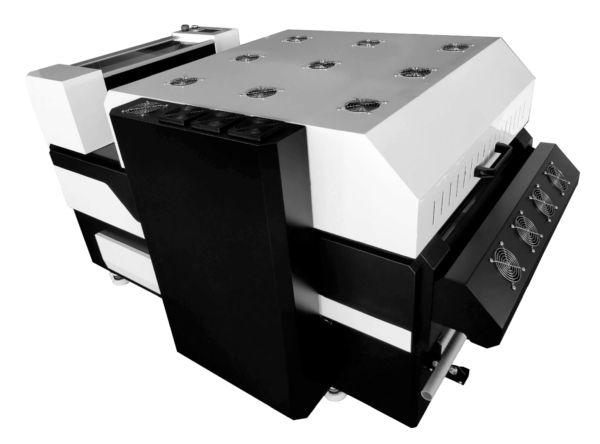
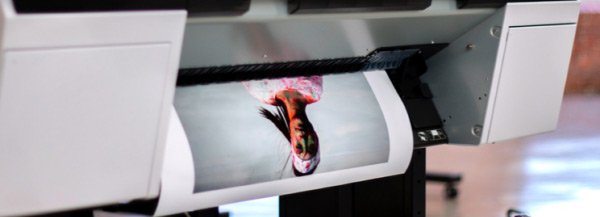
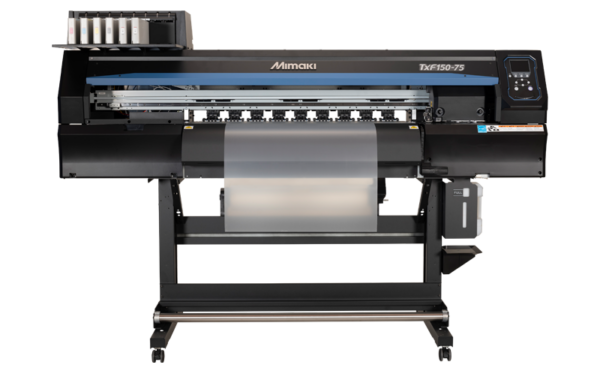
DTF technology leverages what you might call a “wide format inkjet printer” but with a notable twist: it prints designs directly onto rolls of polyester transfer film instead of more traditional media. Manufacturers equip these printers to work with textile pigment inks, including white ink, which is the best for garment printing. After printing, the film enters a “shaker” that coats it with hot melt adhesive powder. This powder sticks only to the ink, and the machine then shakes off any excess.
Finally, the film passes through an attached heater, baking the powder onto the ink. It then rolls onto a take-up reel as it exits the shaker. Despite the detailed process described, it’s important to note that these actions occur seamlessly in a single step. At this point, the film is now prepared for garment application, requiring only 15 seconds under a heat press set at approximately 300°F. With multiple designs printed on each roll of film, they can be cut, either manually or mechanically, before being applied to the garments.
Now that you know how DTF works, let’s dive into all of its advantages!
1. More Automated Process With Lower Labor Costs
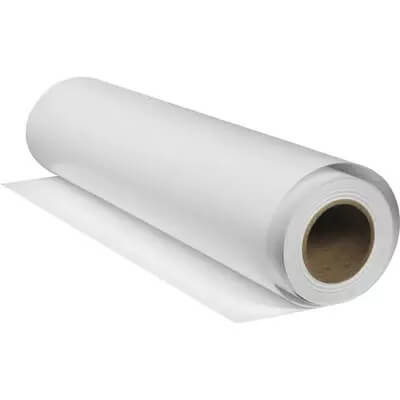
A typical roll of DTF transfer film stretches out to 100 meters. This enables you to print over 300 feet of designs onto the transfer film, which then neatly winds onto the take-up reel for convenient access. Furthermore, cutting each roll into individual graphics can be fully automated using a digital cutter. The final step involves a swift 15-second transfer using a heat press, the only part of the process requiring operator intervention. When you compare it to the workflows of DTG and vinyl transfers, it’s clear that DTF involves significantly less manual labor.
PRO TIP – The efficiency of your workflow hinges on the reliability of your printer. Make sure to invest in a printer known for its dependability. Equally important, purchase from vendors committed to offering solid support you can count on whenever you need assistance.
2. No Garment Pre-Treating
Pre-treating a garment is one of the steps in DTG printing that nobody looks forward to. However, it’s necessary every time white ink comes into play, which is pretty often, considering white ink is a must for any t-shirt color other than white or very light hues. The great news with DTF? You can forget about pre-treating altogether. This saves a step in the DTF process while yielding a higher quality product, as the pre-treatment used in DTG leaves a noticeable outline until you wash the garment.
3. Higher Quality Graphics On More Types Of Garments (Like Sports Apparel)
Textile pigment inks are excellent for garment printing, offering vibrant color, wash-fastness and light-fastness. Plus, they are safe for direct skin contact, emit low to no harmful fumes (making them safer to breathe around) and pose minimal environmental hazards, all of which are common safety concerns associated with alternative inks. But, while you can use these inks on various fiber types, they’re often ineffective in direct printing. Inkjet textile pigment inks are water-based and rely on the fabric to absorb water. For non-absorbent fibers, direct printing methods such as DTG require a significant reduction in ink to prevent wicking and bleeding. This makes DTG printers suitable for cotton and similar cellulosic fibers but less so for synthetic or non-absorbent materials.
This is where DTF shines. DTF prints onto a polyester film coated with an inkjet-receptive layer. This coating ensures the ink stays crisp and clear, eliminating wicking and bleeding as the water content evaporates. Consequently, DTF can transfer high-quality graphics onto a wider variety of fibers, including polyester, nylon and polyethylene, achieving exceptional results across the board.
4. Uses Less Ink
In contrast to direct fabric printing, which often requires more ink because the fibers absorb a significant amount to achieve visible results on the surface, DTF operates differently and more efficiently. DTF prints ink onto a film, where it dries and then adheres to powder before being transferred to the garment. This process ensures that the ink stays on the surface without being absorbed. Comparative tests have shown that DTF can use up to 200% less white ink than DTG printing. The resulting substantial savings add up quickly, providing a noticeable cost-effective advantage.
5. No Weeding Or Pre-Masking
When we talk about DTF printing, it’s often compared to vinyl transfer printing, a method that uses a special film with a paper backing. In vinyl transfer, the process starts with printing your design onto a polyurethane film. After that, you have to cut around the design, weed out the excess film by hand, apply a pre-mask and then peel off the paper backing before transferring it to your garment. It’s a process that requires a lot of hands-on work. For a while, this was the only digital way to print on sports apparel and other synthetic materials, but it was far from perfect, being both time-consuming and costly.
DTF printing streamlines much of this process. It automates several steps, making it less of a manual chore and more cost-effective. With its lower running costs and reduced labor, DTF printing has quickly become the go-to method for printing digitally onto synthetic fabrics.
6. Easy & Fast Application Process
Printing and cutting your DTF film is just the beginning. Once ready, you can apply designs to garments immediately or save them for future use. This capability is perfect for creating a print design inventory, allowing for strategic application to garments as needed. The beauty of DTF lies in its simplicity and speed; the transfer process is so straightforward that it requires only about two minutes of training for anyone to perform.
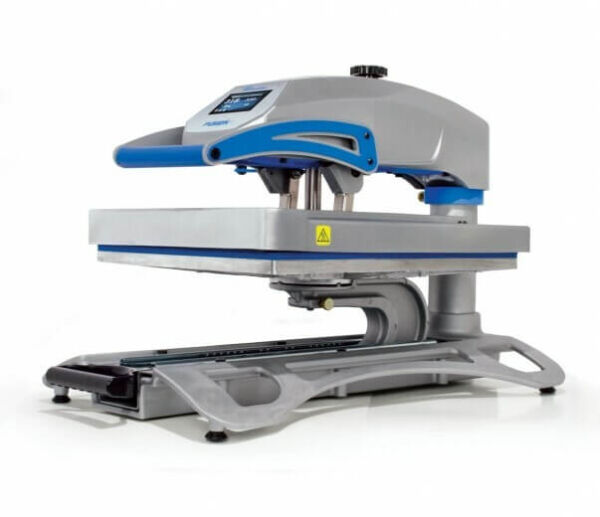
This process is particularly advantageous for retail and event settings. By maintaining a stock of blank garments and printed design films, retail employees can effortlessly apply the customer’s chosen design to the garment of their choice using a standard clam-shell heat press. The convenience doesn’t stop there. Since you need only a heat press for the application, you won’t need to keep bulky printing equipment on-site at retail locations or transport it to events. Simply bring the heat press and your pre-printed films and garments to any event, and you’re ready to go. This makes DTF an ideal solution in dynamic sales environments.
DTF Printing: Setting New Standards In Apparel Production
Direct-to-film printing is rapidly gaining momentum as a practical and effective method for garment printing. From its efficiency and versatility in ink usage to the ease and speed of application, DTF stands out as a forward-thinking solution in the textile printing industry.
Interested in exploring DTF printing for your business? Contact ITNH today for expert guidance and support in making the most of this exciting technology. Let us help you harness the full potential of DTF printing to elevate your production capabilities.