
This is a guest post from Kristen Dettoni of Design Pool Patterns.
Digitally printed upholstery products for commercial interiors are a hot new trend breaking into the market, and this invites exciting opportunities.
But first, what exactly is the commercial interiors market?
Printing Opportunities in Commercial Interiors
Three segments categorize this market:
- Contract (Offices)
- Hospitality (Restaurants and hotels)
- Healthcare (Hospitals and assisted living facilities)
Each of these market areas has a distinctive color palette and particular physical requirements, but overall they need to meet the same basic demands of amazing design, good quality, soil resistance and durability with an element of sustainability.
On top of the basics, each environment also has its own specific challenges. In hospitality, there is the potential problem of food and fluids. As you can imagine, food can drop or glasses of wine can spill on a seat.
In healthcare, there is the concern for bodily fluids such as blood and urine. Though not the most glamorous discussion, these are valid issues for those types of environments, and hospitals especially need to keep their spaces clean and easy to disinfect in order to avoid any additional infections to the patients.
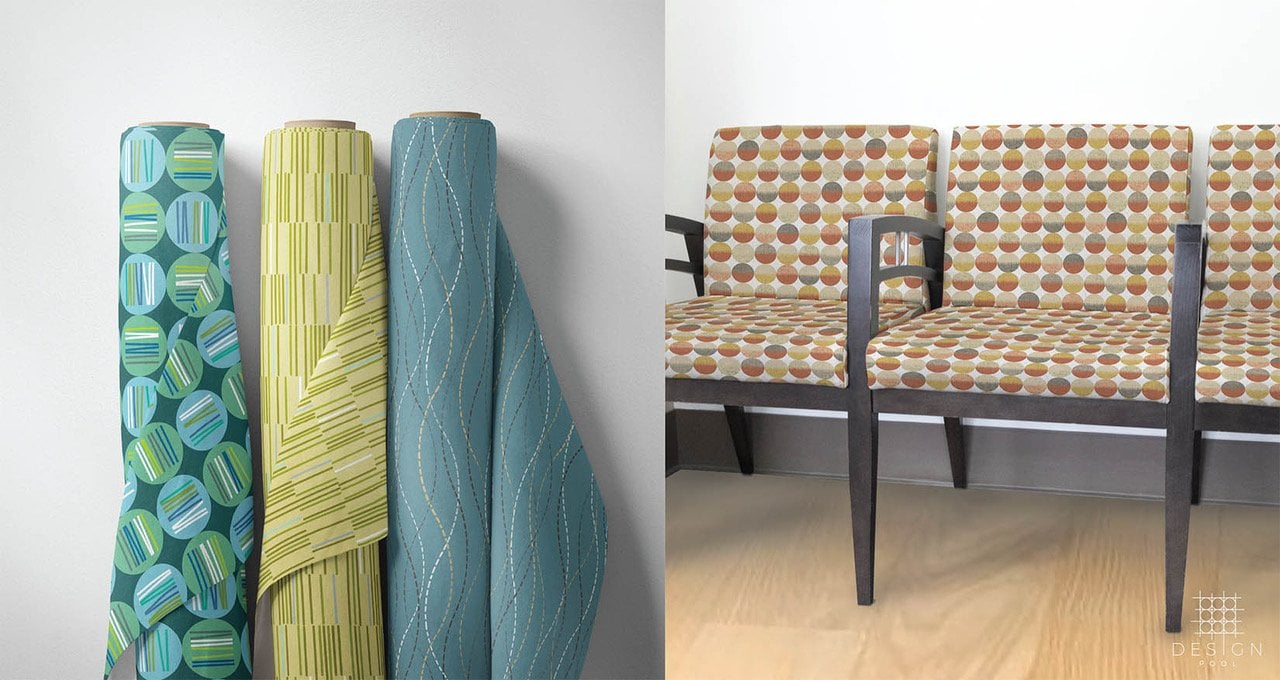
Upholstery products within these spaces consist roughly of 60% printed coated fabrics and 40% woven fabrics. For woven fabrics, the design is created with the weave structures, while coated fabrics are printed vinyls, polyurethanes, or silicone. The popularity of printed coated fabrics is their durability and ease of cleaning. A slick surface makes them easy to wipe clean, making them perfect for high traffic areas such as restaurants, hotels and hospitals.
Creating Printed Fabrics
Today, printed coated fabrics are created with rotogravure printing, which requires a long set up time, large minimums, long lead times, and limited color palettes. The lowest minimum is typically 200 yards per color way, which can be very expensive to stock considering each pattern can have up to eight color ways. Suddenly, 1,600 yards of fabric are sitting on a shelf waiting for a sale.
Set up and development time requires several weeks and often includes a set-up fee. Before a single yard is shown to a customer, a significant investment has already been made. In an attempt to keep costs down, most products are manufactured in Asia or South America, adding even longer delivery lead times of usually 3 – 16 weeks and import fees. Colors are also limited. Each manufacturer uses different inks and every color in a design requires a different roller, restricting your design capabilities. Lastly, design file set up also varies between manufacturers.
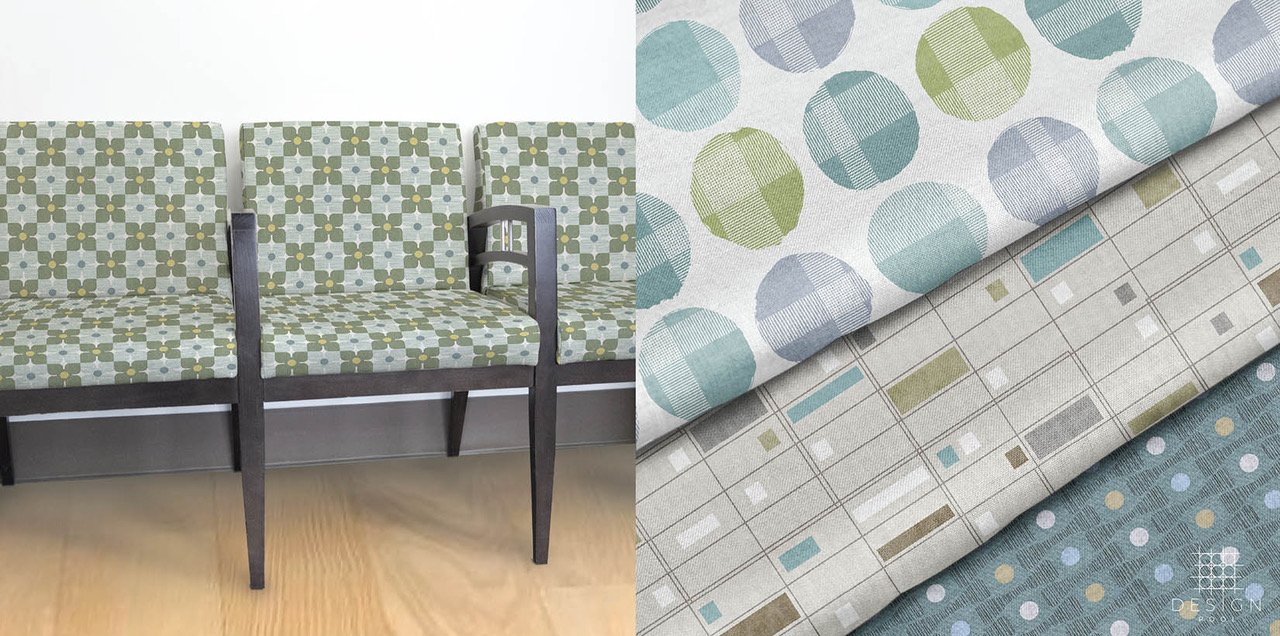
Most jobbers in the United States buy from manufacturers, stock inventory, then sell the fabrics to interior designers, but with this type of manufacturing they are limited in what they can offer, resulting in very few designs and color ways. Custom work, where an interior designer would work directly with the jobber to create a unique product specific to their project, is almost always out of the question. This creates an additional problem for an interior designer updating part of an existing space when needing to match to a current wall color or flooring exactly.
Digital Textile & Fabric Printing
With all these challenges comes an amazing opportunity, digital textile and fabric printing, which eliminates every issue. Gone are the long lead times, high minimums, and limited colors. In its place is the potential to have your sample printed locally, on the same day with manufacturing starting immediately after the sample is approved.
From a design perspective, it is a dream! There are no repeat limitations and no need for color separations. It can be as simple as designing in Illustrator on a single layer and emailing the file. This also makes it a breeze for color matching since Adobe offers a series of color books such as Pantone, Toyo and Trumatch. Just click a button to apply a customer approved color.
One company printing successfully for healthcare upholstery is LDI Corporations’ Enviroleather product. Located and manufactured in Portsmouth, New Hampshire, LDI carries a line of 16 patterns to showcase their capabilities, and offers endless possibilities for custom colors and designs. All that, plus only a five-yard minimum. Enviroleather is digitally printed on a faux leather polyurethane substrate that meets all the physical requirements required such as bleach clean ability, high abrasion and sustainability.
When it comes to custom designs, LDI works with Design Pool to create new designs or taps into Design Pool’s licensable library specifically designed for commercial interiors.
BIFMA estimates that combined markets consist of $16 billion in furniture, and LDI and Design Pool see a huge potential for the future of surface printing. With these new printing and ink technologies, you’re only limited to your imagination.
We look forward to seeing more printed upholstery products in commercial interiors and hope the print-on-demand business model infiltrates other surfaces in commercial interiors such as carpet, panels, tabletops and wallcoverings.
Imagine the possibilities! We already have here at Design Pool.